
Are you looking for a tax lawyer in Hartford, CT?
We provide tax debt resolution guided by 43 years of experience in Hartford, CT and the surrounding area.
If you owe money to the IRS or the State of Connecticut and aren’t sure what step to take next, a tax attorney in Hartford can help you figure out your options before the situation gets worse. Tax debt doesn’t sit still. Interest builds, penalties stack, and the government has collection tools that most creditors don’t have access to.
At The Law Offices of Neil Crane, we have spent more than four decades helping individuals and small business owners across Connecticut work through serious tax problems. Schedule a free consultation with our Hartford, CT tax lawyer.
Tax Lawyer Hartford, CT
A tax lawyer represents individuals and businesses in disputes with government taxing authorities. That includes the IRS, the Connecticut Department of Revenue Services, and in some cases, local agencies. If you’ve received a notice of deficiency, a federal tax lien, or a letter threatening levy action, you are already dealing with the collection process.
The role of a Hartford tax attorney goes well beyond filing paperwork. We review what you owe, determine whether any part of the balance qualifies for reduction or settlement, and deal directly with the taxing authority on your behalf. That could mean negotiating a payment plan, pursuing an offer in compromise, or defending against collection activity that’s already underway.
Types of Tax Cases We Handle in Hartford
Not every tax problem looks the same. Some clients owe money from a single bad year. Others haven’t filed in a decade and don’t know where to begin. Below are the types of tax matters we regularly handle for individuals and businesses in the Hartford area.
- IRS Back Taxes. If you owe the IRS for one or more prior years, the combined penalties and interest can eventually exceed the original tax balance. We negotiate with the IRS to reduce what you owe or arrange a payment structure that fits your actual financial situation.
- Connecticut State Tax Debt. The Connecticut DRS enforces its own collections, including liens, bank levies, and intercepted refunds. We handle state income tax matters at both the administrative level and in formal proceedings when necessary.
- Offer in Compromise. An offer in compromise allows you to settle your federal or state tax debt for less than what you owe. Qualification depends on income, assets, and ability to pay. We prepare and file these applications for Hartford, CT clients.
- Installment Agreements. When full payment isn’t possible and settlement isn’t available, a structured monthly plan may be the most realistic path. We negotiate installment agreements with the IRS or DRS that reflect your actual income and expenses.
- Tax Liens and Levies. A federal tax lien attaches to everything you own. A levy goes further and takes your property or wages. We work to get liens released or subordinated, and we challenge levies that cause undue hardship, including cases involving real estate tax foreclosure.
- IRS Wage Garnishment. The IRS can take a portion of your paycheck without a court order. If your wages are already being garnished, we work to get the IRS wage garnishment reduced or released while pursuing a permanent resolution.
- Payroll Tax Debt. Small business owners who fall behind on payroll taxes face personal liability through trust fund recovery penalties. The IRS treats these cases aggressively. We represent Hartford business owners navigating this type of enforcement.
- Tax Debt in Bankruptcy. Some tax obligations qualify for discharge under Chapter 7 or Chapter 13 bankruptcy, depending on how old the debt is and what type of tax is owed. We assess whether you can discharge certain taxes and manage both the tax and bankruptcy sides when that path makes sense.
Why Choose The Law Offices of Neil Crane as My Tax Lawyer in Hartford, CT?
Four Decades of Tax Debt Resolution in Connecticut
Neil R. Crane founded the firm in 1983 and has handled more than 15,000 cases involving bankruptcy, tax debt, foreclosure, and related financial matters. He earned his J.D. from UConn School of Law and is admitted to practice in Connecticut, the U.S. District Court for the District of Connecticut, and both the Southern and Eastern Districts of New York.
Neil has received the Martindale-Hubbell Distinguished rating for multiple consecutive years and the Client Champion Award in 2020. He is a member of NACBA, the national association for consumer bankruptcy attorneys, and the American Bankruptcy Institute, and has been featured in the New York Times, on the BBC, and on Swiss television discussing consumer debt. He has also traveled to Congress on multiple occasions to lobby for consumer rights.
We offer free initial consultations for all tax matters, and our client reviews reflect outcomes built over four decades in practice. When you bring a tax matter in Hartford, CT to our firm, you draw on that record across IRS disputes, state tax collections, and bankruptcy tax protection strategies.
Understanding Tax Cases
IRS Resolution Programs and Eligibility
The IRS offers several formal programs for taxpayers who can’t pay their full balance. Each one works differently, and eligibility depends on your financial circumstances.
- Offer in Compromise (OIC): An OIC settles your tax liability for less than the full amount owed when the IRS determines it cannot collect the full balance within the collection period. OIC payment options include lump-sum and periodic structures.
- Installment Agreement: An installment agreement lets you pay the balance through monthly payments over several years, provided your payments satisfy the debt within the collection statute.
- Currently Not Collectible (CNC) Status: CNC status halts IRS collection activity when paying would cause financial hardship, though interest and penalties continue to accrue.
- Penalty Abatement: The IRS may waive penalties if you demonstrate reasonable cause for the failure to file or pay, such as illness, a natural disaster, or reliance on incorrect professional advice.
- Innocent Spouse Relief: This provision protects one spouse from liability caused by the other spouse’s errors or omissions on a joint return.
A tax lawyer in Hartford evaluates which program fits your situation and prepares the financial documentation the IRS requires.
Hartford Tax Infographic
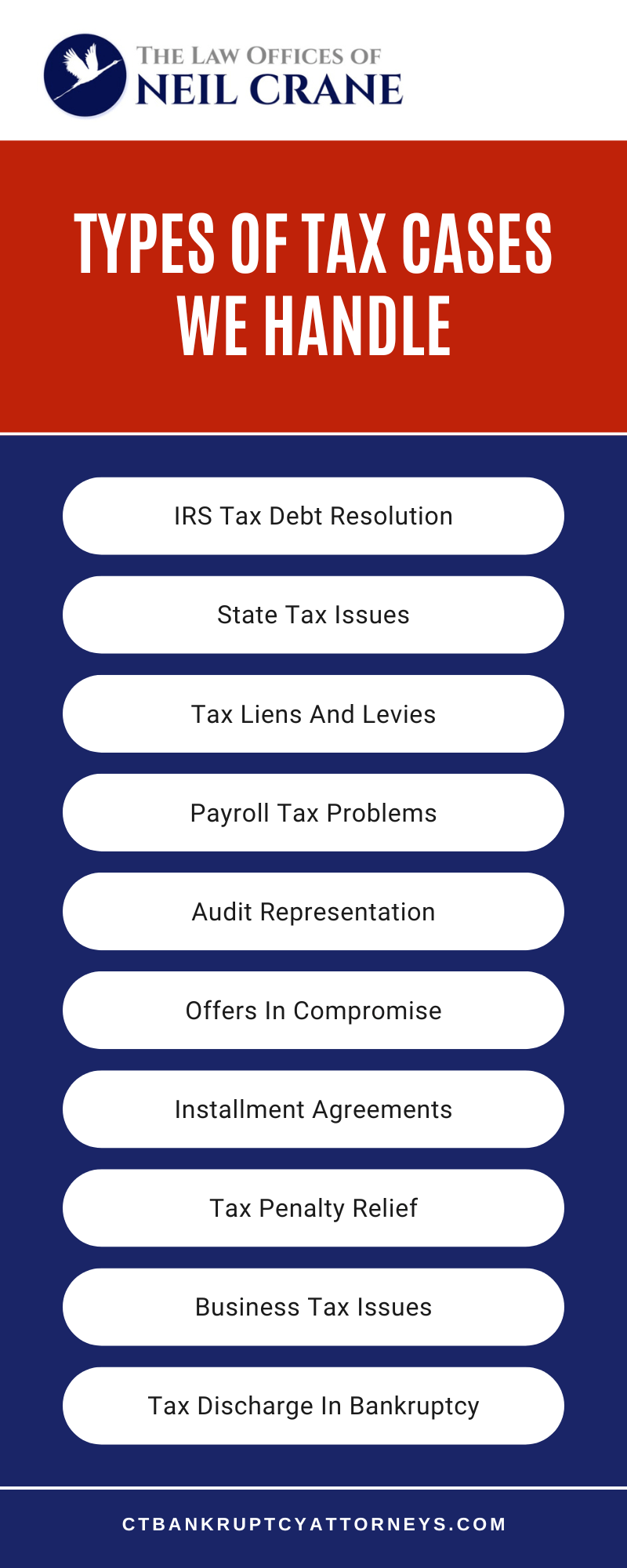
What Are Important Aspects of a Tax Case?
No two tax situations are identical, but several factors consistently shape how a case unfolds.
The type of tax debt matters. Federal income tax, state tax, and payroll tax obligations each follow different rules. Some may eventually become eligible for discharge through bankruptcy. Others will not, no matter how old they are.
Age of the debt is significant. The IRS generally has ten years to collect, but certain events can extend that window. Filing for bankruptcy triggers an automatic stay that pauses collection and may also toll the statute of limitations.
Your financial picture determines what you qualify for, since the IRS reviews income, assets, and expenses before agreeing to any reduction. Compliance history also matters: the IRS is far more likely to grant relief if your returns are current and you have been making a good-faith effort.
What Is the Tax Case Timeline?
Tax cases don’t follow one predictable schedule, but here is a general idea of what to expect once you retain a Hartford, CT tax attorney.
- Initial review and return filing (1–4 weeks): We assess your situation, request IRS transcripts, and make sure all required returns are current.
- Program selection and application (2–6 weeks): We gather your financial data and prepare the appropriate submission.
- IRS review period (3–12 months): The IRS assigns a revenue officer or processes your application through its automated system. OIC applications commonly take six months to a year.
- Negotiation and resolution: If the IRS counters or requests documentation, we handle the response. Simpler cases resolve in months; complex matters can take longer.
- Compliance monitoring: After resolution, the IRS monitors your compliance for a set period. Staying current on future returns and payments is essential.
What Should You Bring to Your Tax Consultation?
Before meeting with a tax attorney in Hartford, CT, it helps to have the following ready:
- IRS or state tax notices, letters, or any collection documents you’ve received
- Tax returns for the last three to five years, or a list of years that remain unfiled
- W-2s, 1099s, and any other income records
- A summary of your monthly expenses and current debts
During the consultation, we review your tax history, explain which resolution paths apply to your circumstances, and outline the next steps. Consultations are free, and there is no obligation.
What Are Important Connecticut Legal Resources for Tax Cases?
Connecticut residents facing tax debt have access to several government resources that provide information on available programs, eligibility criteria, and taxpayer protections. These can help you get oriented before or during legal representation.
- The IRS Offer in Compromise page explains federal eligibility requirements and the application process for settling tax debt below the full amount owed.
- The IRS installment agreement page covers payment plan options for taxpayers who owe but cannot pay everything at once.
- The IRS Taxpayer Advocate assists individuals whose tax issues haven’t been resolved through standard IRS channels.
- The Connecticut DRS administers state tax obligations and posts information on filing requirements, refund status, and debt payment options.
- The U.S. Tax Court provides guidance for taxpayers who need to dispute an IRS determination before an independent federal court.
Reach Out to The Law Offices of Neil Crane to Schedule a Consultation
If tax debt is putting pressure on your finances, our firm is ready to help you work toward a resolution. We offer free consultations for individuals and business owners facing IRS or Connecticut state tax problems. Contact us to speak with a Hartford tax attorney about your case.